Right now, we are knee-deep in fixing our family room. As I explained in this post, when Comcast installed a cable jack in our family room, the tech drilled through the clean-out line pipe.
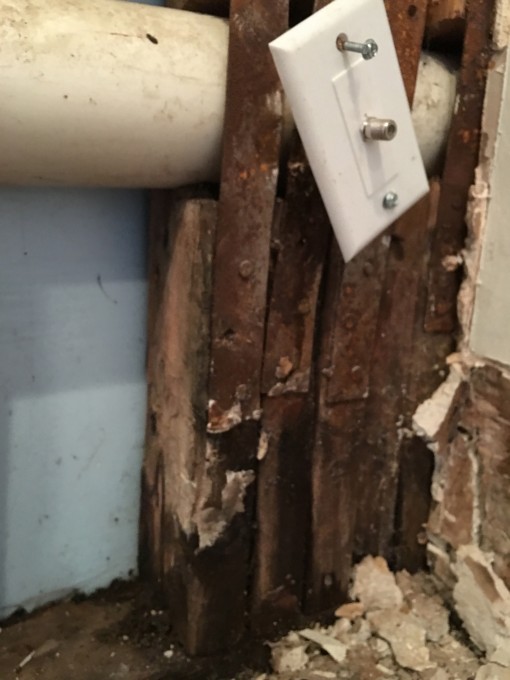
Clear through it.
Once our contractor cut away the drywall, we could see the damage: the drywall was all wet, the wood in the walls was all wet, the floor and subfloor were all wet, and there was mold.
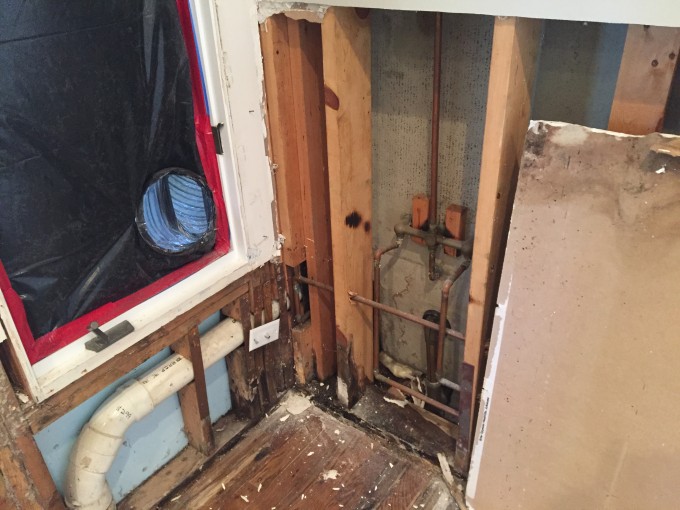
Yep: wastewater/sewage leaking for a year plus organic building materials = whole lot of yuck, including mold.
The remediation company has removed the wet drywall and wood and killed the mold. We’ve been running the negative-pressure fan (that’s the duct coming out of the sealed window) in there since last Wednesday, to make sure the moisture and smell are gone before we rebuild.
Speaking of rebuilding, that starts today. There are now two parts to rebuilding this area of the family room.
First, when we removed the drywall to find the leaking pipe, we saw that, when the family room addition was built, the plumber who installed that pipe cut through the support studs to make room for the pipe.
If I live to be 100, I will never understand why people cut through support studs. But they do – we found it in our old house and now in this one. So, before we can re-drywall and all that, we have to build a structure to support the wall.
And by “we,” I mean my lovely contractor and his carpentry crew.
Once that structure is added, then we can replace the floor and drywall.
And that’s part two of the rebuilding: new subfloor, new wood floor, new drywall, new paint. That’s what’s on Comcast for the damage its tech caused.
Here’s what I’ve learned about water leaks, mold, and remediation:
(1) Trust your nose. It always knows.
Toucan Sam (Remember? Froot Loops?) was right – trust your nose. If you smell mold, mildew, or a musty smell, chances are that there’s a leak and mold that’s growing as a result. That’s how I first knew there was a problem before anyone cut into the wall to check: I could smell it.
(2) What to do if you suspect mold.
If you suspect mold, do not just go and cut into the wall. If you disturb the mold, you’ll end up with the spores spreading into the air in your home and you do not want that. Also, if the mold is in an open area, do not run a fan in that area until you have the mold remediated. That would spread the mold throughout your home = bad.
Instead, call a professional. Ask friends or contractors you know to find a reputable mold remediation company. They will don masks and hazmat suits and contain the mold, remove it from your home, and apply chemicals that make it go away for good. They should use proper ventilation and containment procedures to ensure the mold doesn’t spread.
Mold removal and remediation is NOT a DIY project. Don’t try this yourself.
(3) Check and repair.
While the floor or subfloor and walls are all opened up, check to make sure nothing else needs repairing.
For example, we found the support problem once we opened up the wall with the leak, and that’s going to be fixed first. You never know what you’ll find when you open up a wall, so be prepared to find something and fix it while you can.
(4) The Power of Social Media.
In our case, Comcast clearly caused this leak and the resulting damage. We have the proverbial smoking gun of the cable wire through the pipe.
I called Comcast immediately upon learning that the jack was through the pipe. I called Comcast four times with no response back. When calling didn’t work, I went to social media. I messaged Comcast on both Facebook and Twitter and, within 24 hours, someone responded. Moral of the story: if at first you don’t succeed, try social media.
To see our family room without plastic sheeting and fans, click HERE.
For a tour of our 1929 home, click HERE:







 Dogs Don't Eat Pizza
Leave a reply to Karen Cooper Cancel reply